
Field Notes
What I Learned Walking ORGATEC: You Cannot Judge a Chair by Looking at It
Pierre Courso reflects on office chair trends at ORGATEC 2026: familiar task chairs, deeper recline, and new approaches to how we sit and work.
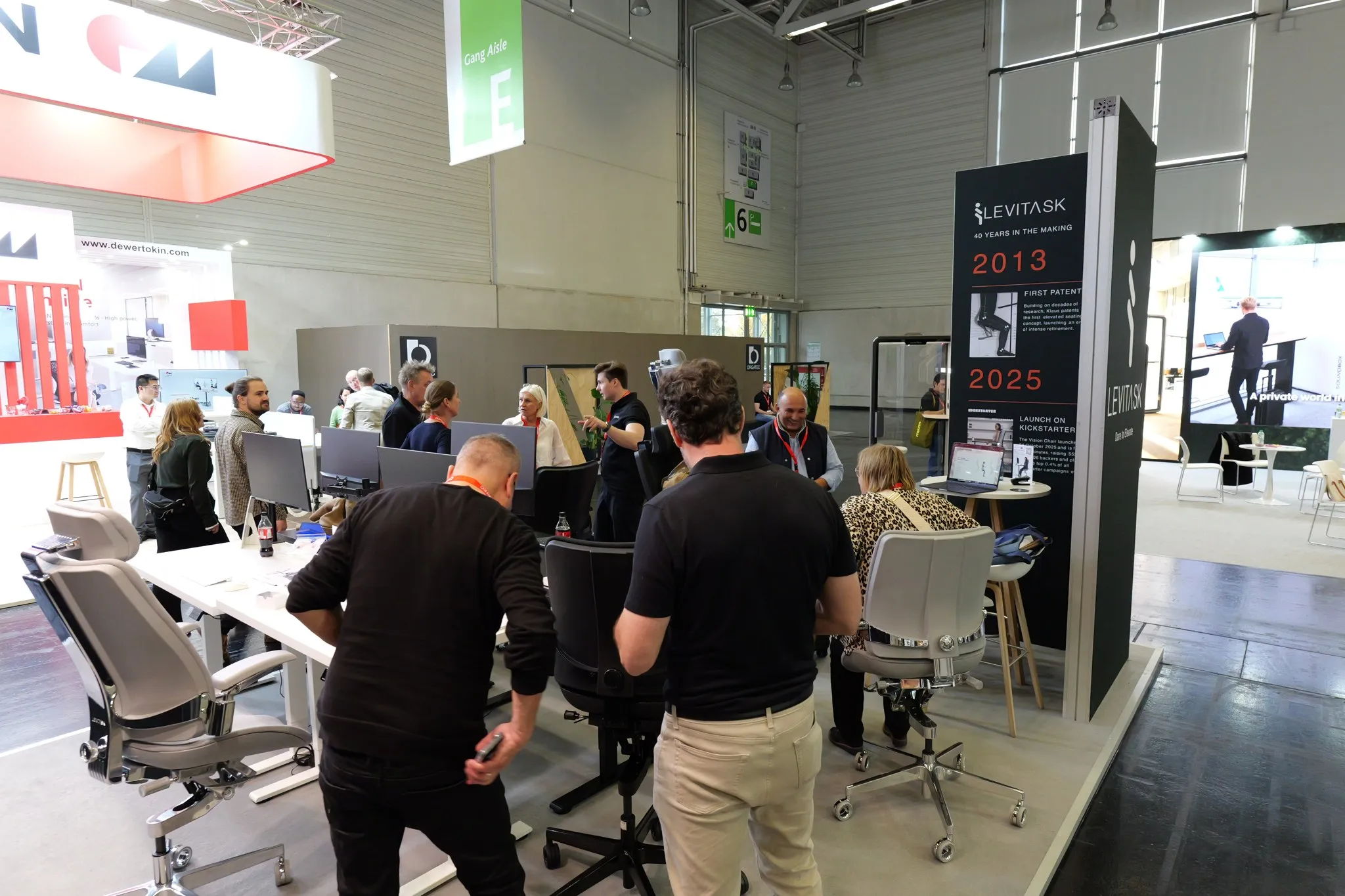
By Pierre Courso, Levitask
I spent four days at ORGATEC in Cologne this year and sat in every chair I could. That last part matters more than it sounds.
I was there with Levitask, so I naturally looked at the fair through the lens of what we are building. But walking the halls was also a chance to question my own assumptions. One chair, in particular, reminded me how quickly appearances can lead you to the wrong conclusion.
You have to sit in it
From three metres away, a task chair tells you very little about how it will feel. The mesh looks technical, the lumbar curve looks supportive, the recline looks generous. You can form an opinion before you have touched it.
I walked past a chair that looked almost perfectly upright. Given our focus on opening the angle between the torso and thighs, it seemed about as far from our philosophy as a chair could get. My first thought was that it would be uncomfortable.
Then I sat down. The backrest moved, my position changed, and the experience was much more comfortable than its appearance had suggested. I was glad I had stopped.
That is the first thing I would tell anyone shopping for a chair: put the spec sheet aside for ten minutes and sit in your actual working position. Imagine your keyboard in front of you. Reach for something. Lean back, then return to work. Notice whether the support is still where you need it.
A short trial cannot tell you everything about a full working day, but it can tell you things a photograph never will. The way a chair looks and the way it behaves are not necessarily the same story.
The copy-paste halls
The second impression was how familiar much of the task-chair category felt. Different mesh, different armrest caps, different silhouettes, but often a similar starting point: a fairly flat seat, an adjustable backrest and a mechanism linking the two as you recline.
There is real engineering in refining those details, and the chair that surprised me was a useful reminder not to dismiss them. Still, after enough halls, I found myself asking how many of these designs were improving an established way of sitting, and how many were reconsidering it.
For me, that was the most interesting question behind the office chair trends at ORGATEC: are we adding features to the familiar task chair, or changing the relationship between our bodies, the chair and the desk?
The recovery arms race
Another theme that caught my attention was rest. Deep recline, leg rests, massage functions and positions described as zero gravity. Some were impressively engineered, and I could see why people enjoyed trying them.
There is nothing wrong with a chair that helps you take a break. But I kept coming back to a different question: what happens during the hours when you are actually working?
A dramatic recline is easy to demonstrate on a trade-show floor. How well a chair supports you while you type, read or move between tasks is less spectacular. It deserves just as much attention.
I do not think the choice has to be work or rest. I would simply like to see as much ambition applied to the working position as to the reclined one.
Where I saw the most interesting ideas
The parts of the fair that stayed with me explored alternatives to conventional sitting: walking desks, under-desk bikes, active stools, saddle chairs and higher, more open seating positions.
Each asks something different of the person using it. Walking or pedalling changes the rhythm of desk work. Some stools and saddle designs offer more freedom to move but less back support. I enjoyed trying them, while wondering which I would choose for a short change of position and which I could imagine using for a longer working session.
Those are questions to explore through use, rather than settle after a few minutes at a stand. What encouraged me was seeing other companies take them seriously.
What that meant for our own vision
At Levitask, our approach is Elevated Seating: a forward-inclined seat that raises the hips above the knees, paired with a backrest that moves with you. The aim is to offer a more open working position while retaining the support people expect from a task chair.
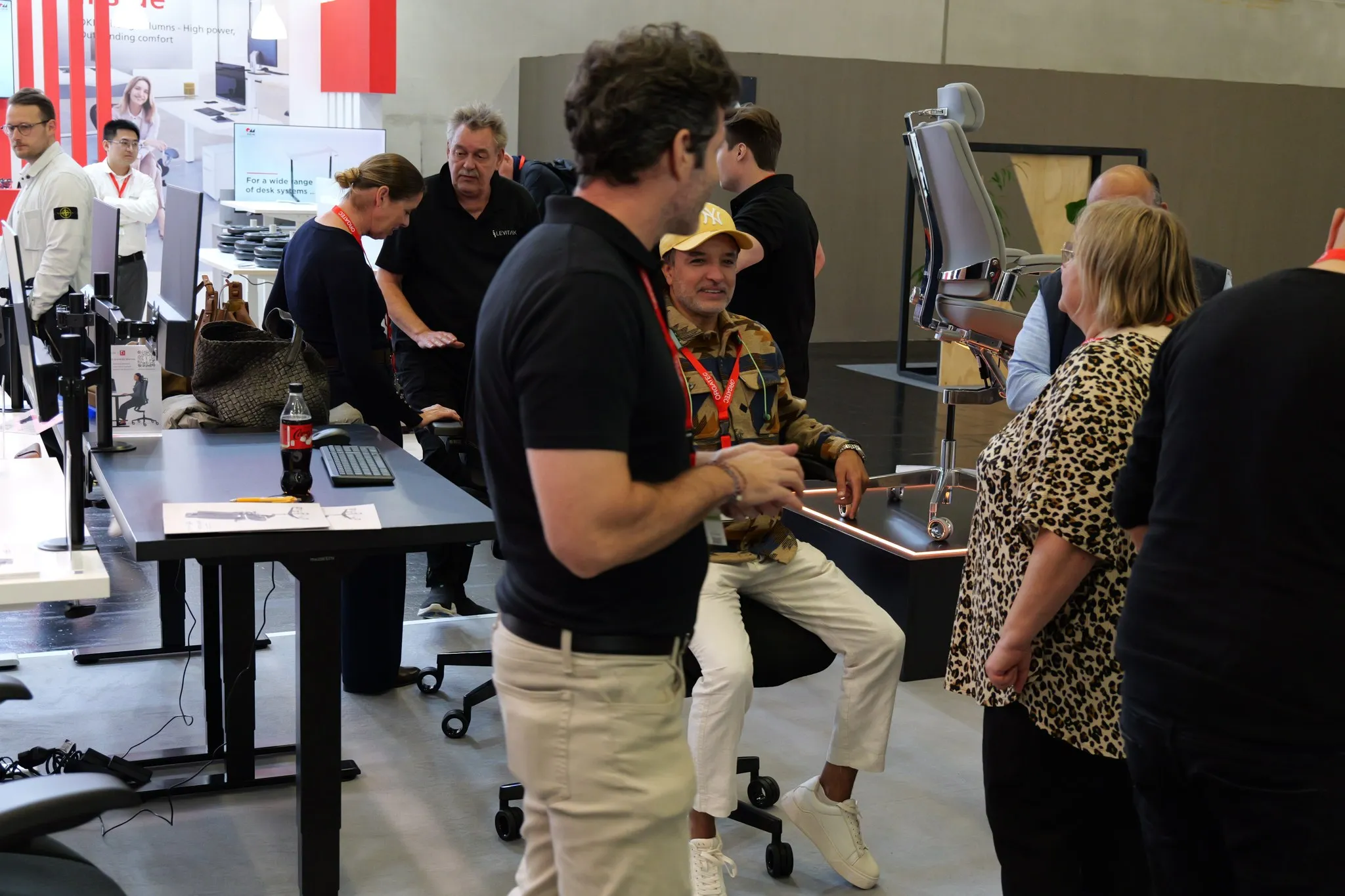
Seeing other approaches across the fair, then returning to the conversations at our own stand, strengthened my confidence in that direction. Visitors could try the Vision Chair, compare it with what they had just experienced elsewhere and ask us specific questions about the difference.
For me, ORGATEC validated the vision behind what we are building: there is interest in rethinking how we sit, and an appetite for alternatives that people can experience for themselves. The next chapter is taking that experience beyond the exhibition stand and into everyday working life.
What I took home
I left Cologne with more conviction about our direction and a healthy reminder to keep an open mind about other people's ideas.
The chair I nearly walked past was one of the most useful lessons of the week. Try it before you judge it. Look beyond the feature list. And pay at least as much attention to how a chair supports you at your desk as to how far it lets you lean away from it.
The most interesting question is not how many features we can add to a chair. It is how well the whole thing works when someone sits down to work.
For a closer look at the different approaches, our complete guide to alternative seating covers saddle chairs, kneeling chairs, active stools and elevated designs. You can also read our ORGATEC 2026 recap for more from the Levitask stand.